
While experts agree there is a connection between housing and health outcomes, an official with an Arkansas nonprofit says the state's lack of strong renter protections makes it harder for people in poor housing situations to achieve better health results.
Cory Crawford, a managing partner of Legal Aid of Arkansas, describes landlord tenant law in the state as the worst in the nation with little in the way of protection for tenants.
One of the few rights tenants do have is the warranty of habitability, which requires a landlord to make a rental unit habitable, Crawford said. However, proving a habitability issue exists is not without its challenges.
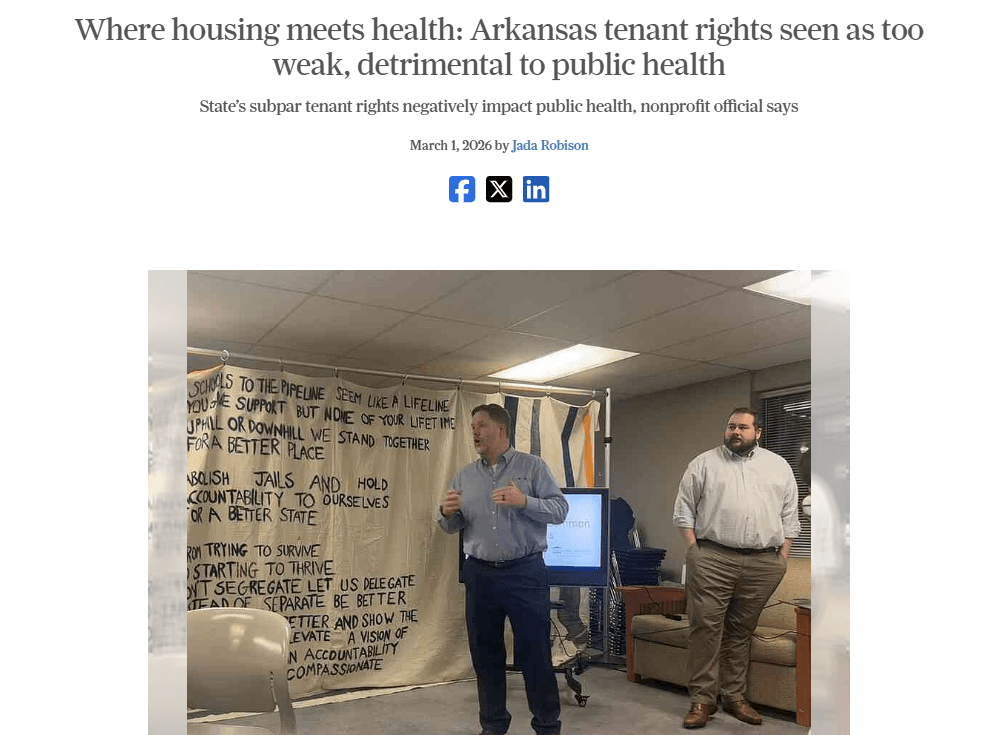
Crawford, during a Feb. 9 presentation at the Fayetteville Public Library, was asked if a landlord would be required to remove mold from a property. He said for that to happen, a tenant would have to go to a doctor and receive proof that a medical condition was being caused or exacerbated by the mold in order to justify removing it.
Mark Burbank encountered issues with habitability at his apartment in Little Rock in 2021 when sewage began to flow into his tub. Even after hours of scrubbing with cleaning and unclogging products, the toilet refused to flush. He couldn't wash dishes and had to walk to his sister's nearby apartment to shower.
Burbank made complaints almost daily to apartment managers, and the problem continued without repair for over a week, he said.
A sanitary sewage system and plumbing that conforms to "applicable building and housing codes in existence at the time of installation" is one of six measures guaranteed to Arkansas tenants under a law passed during the state General Assembly's 2021 session. That was the first time Arkansas mandated statewide standards for rental housing.
The other measures guaranteed under the 2021 law are:
A source of hot and cold running water.
A source of electricity.
A functioning roof and building envelope.
A functioning heat and air conditioning system to the extent it served the premises at the time the lease began.
Under Act 1052 of 2021, tenants can move out without penalty and get their security deposits returned if landlords don't provide a sanitary sewage system, among other requirements. Tenants must be current on their rent, and landlords have 30 days to remedy problems. Burbank said he might have used that option if the new law had been in effect when he signed his lease.
State Sen. Kim Hammer, R-Benton, said as a landlord, he's experienced both good and bad tenants and believes there's a balance to be had between landlord and tenant. He believes there are safeguards in place to hold people accountable on both sides, but as with anything else, there's always room for improvement, he said.
WHAT THE RESEARCH SAYS
Home design and structure significantly influence housing quality and may affect both mental and physical health, according to the U.S. Department of Health and Human Services.
Poor housing quality and inadequate conditions such as the presence of lead, mold or asbestos, and poor air quality can contribute to negative health outcomes, including chronic disease and injury, a research summary from the department states. Even low levels of lead exposure can have serious effects on children's health and behavior, including nervous system and cognitive development.
The summary also mentions that physical and structural housing conditions disproportionally impact children, older adults, individuals with physical disabilities and low-income individuals. Children's behaviors, such as hand-to-mouth activity, can increase exposure to home pollutants that may affect their growth and development. Addressing the quality of housing as a public health issue may help prevent and reduce negative health outcomes, according to the department.
A study by the Arkansas Center for Health Improvement last year found that housing plays a key role in health, shaping exposure to risks and access to resources across every stage of life. A person's environment influences access to education, employment, public safety, proper nutrition, medical care and transportation. In Arkansas, deficits in these areas are linked with increased morbidity and reduced life expectancy, especially in certain areas of the state, the study states.
The study found a more than 10-year difference in average life expectancy exists between Phillips County (68 years) and Benton County (78.8 years). Polk County, which is ranked as one of the worst counties in the state for severe housing problems, has a life expectancy of 72.6 years, two years below the average life expectancy in Arkansas and almost five years below the national average, the study states.
Katharine Robb, a senior research associate in the Bloomberg Center for Cities at Harvard University, uses data to understand how city resources can be used to improve housing and health, assessing health inequalities and neighborhood dynamics.
"Poor quality housing impacts health through multiple, reinforcing pathways," Robb said. "Exposures inside the home, like mold, particulate matter, pests, lead or even extreme temperatures can directly contribute to asthma, other respiratory conditions, cardiovascular disease and other chronic illness. The impacts go beyond physical hazards."
Robb said her research often focuses on how housing quality is not just a building-level issue, but a systems-level issue shaped by factors like underfunding of public housing authorities, accountability breakdowns, bureaucratic fragmentation in housing inspection and more. These dynamics shape exposure patterns and residents' ability to secure safer housing, she said.
Poor housing rarely acts alone -- it intersects with neighborhood disinvestment, environmental injustice, legacies of structural racism and other inequities, she said.
HARD CHOICES
Fayetteville City Council member Monique Jones said when families are experiencing issues like poor ventilation, mold, rodents or even just structural issues, it can increase stress and cause health problems.
Additionally, housing instability will often cause families to delay going to the doctor, and because Arkansas doesn't have strong renter's rights, there's no commitment to make a landlord bring a rental unit up to code, Jones said. High housing costs force families to make difficult choices, like skipping medical appointments, delaying treatment or choosing cheaper or less nutritious food, she said.
Fayetteville launched a one-year Housing Crisis Task Force in 2024 after the city declared a housing crisis.
The median house value has grown 275% in the last two decades and the median gross rent has increased 78%, according to Fayetteville's April 2025 housing assessment. Median household income has increased by 64%.
The task force presented its final findings to the City Council in July. Recommendations included setting up an emergency housing fund, updating zoning regulations, streamlining city inspection and permit approval processes and setting up advisory groups.
In September, Fayetteville Mayor Molly Rawn said the housing crisis was "a very big puzzle" and city ordinances and programs could only address some parts of that puzzle. She said renter protections issues, for example, are "very much a state issue" and those interested in changing that part of the problem need to contact state legislators.
For Jones, the reason housing affordability should be viewed as a public health issue is simple: "It determines whether people can meet their basic needs and access what they need to survive every single day."